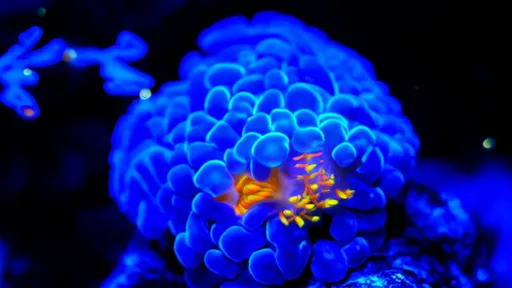
In a groundbreaking discovery that could revolutionize coral reef conservation, marine biologists have identified a precise "fluorescent distress signal" emitted by symbiotic algae when coral approaches its bleaching threshold. This natural early-warning system, detectable through specific spectral signatures, provides scientists with a critical window to intervene before irreversible damage occurs to these vital marine ecosystems.
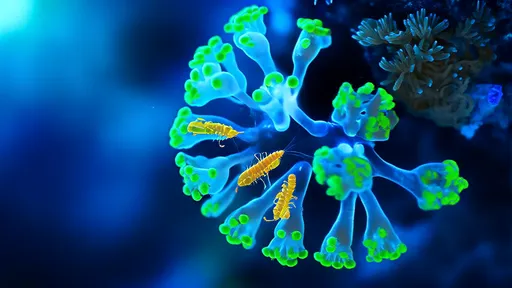
The phenomenon occurs when the delicate partnership between coral polyps and their photosynthetic zooxanthellae (Symbiodinium) begins breaking down under environmental stress. As water temperatures rise beyond tolerance levels, the algae's photosynthetic machinery becomes impaired, triggering a cascade of biochemical changes that manifest as distinct fluorescence patterns. Researchers using hyperspectral imaging have now mapped these spectral fingerprints with unprecedented precision.
What makes this discovery particularly remarkable is how consistently these fluorescence changes predict impending bleaching events across different coral species. The algae begin emitting modified fluorescence signatures up to 72 hours before visible bleaching occurs - a crucial timeframe when mitigation efforts could still save the coral colony. This biological early-warning system operates through complex photoprotective mechanisms that algae activate under stress.
Scientists have identified three key fluorescence signatures that serve as bleaching predictors. The most significant involves a measurable shift in chlorophyll fluorescence peaks at 685nm, accompanied by distinctive changes in the spectral region between 450-550nm where protective pigments like xanthophylls operate. These spectral changes reflect the algae's desperate attempt to dissipate excess light energy as heat through non-photochemical quenching pathways.
The practical implications for reef conservation are profound. Current monitoring methods often detect bleaching only after it becomes visible to the naked eye, when coral has already expelled most of its symbiotic algae. By contrast, this fluorescence signal provides an objective, quantifiable metric of subcellular stress that can be detected using underwater spectrometers or even modified camera systems deployed on drones or underwater vehicles.
Field tests on Australia's Great Barrier Reef demonstrated the method's effectiveness during the 2023 bleaching event. Researchers successfully predicted bleaching outcomes with 89% accuracy by monitoring spectral changes in Porites and Acropora colonies. The system proved particularly valuable in distinguishing between temporary thermal stress and irreversible bleaching trajectories - a critical distinction for conservation prioritization.
Beyond temperature stress, the spectral signatures appear sensitive to other environmental threats including ocean acidification and pollution. Preliminary evidence suggests different stressors produce subtly distinct fluorescence patterns, potentially creating a diagnostic toolkit for identifying specific threats to reef health. This multi-threat detection capability could transform how marine parks allocate protective resources.
The technology's development hasn't been without challenges. Early versions struggled with signal interference from water depth and dissolved organic matter. However, advanced algorithms that account for these variables now provide reliable readings even in turbid coastal waters. Next-generation portable spectrometers designed specifically for this application are currently being field-tested by several marine research stations.
Perhaps most exciting is how this discovery bridges cellular biology with ecosystem-scale conservation. The fluorescence signals originate from quantum-level processes in algal chloroplasts yet manifest as detectable changes across entire reef systems. This connection between molecular biology and visible ecology provides scientists with a powerful new lens for understanding coral resilience.
Conservation organizations are already adapting management strategies based on these findings. The Nature Conservancy has incorporated fluorescence monitoring into its reef resilience network, while several Pacific island nations are testing early warning systems that trigger localized cooling interventions when critical fluorescence thresholds are reached. Such interventions might include artificial upwelling or temporary shade structures.
The discovery also raises intriguing evolutionary questions. The precision of these fluorescence signals suggests they may represent an ancient communication system between coral and symbionts, potentially allowing some colonies to selectively retain more heat-resistant algae during stress events. This evolutionary perspective could help identify naturally resilient "super corals" for assisted migration projects.
Looking ahead, researchers aim to develop standardized fluorescence metrics that can be incorporated into global reef monitoring networks. International collaborations are working to create shared databases of spectral signatures across different coral-algal combinations and environmental conditions. Such efforts could eventually lead to a global "bleaching early warning system" analogous to meteorological storm forecasts.
While the technology shows immense promise, scientists caution it's not a silver bullet for reef conservation. Fluorescence monitoring complements rather than replaces existing management strategies. Its true value lies in buying precious time - allowing interventions before corals reach the point of no return in the bleaching process. As climate change intensifies, such early warning systems may prove vital in preserving what remains of the world's coral ecosystems.
The research underscores how much we still have to learn about coral-algal symbiosis. What we once viewed as a simple partnership now appears to involve sophisticated biological communication systems - with fluorescence serving as both distress signal and potential survival mechanism. As investigation continues, these tiny light signals may illuminate not just bleaching thresholds, but fundamental truths about life's interconnectedness in our oceans.

By /Aug 18, 2025
By /Aug 27, 2025

By /Aug 27, 2025
By /Aug 18, 2025
By /Aug 27, 2025
By /Aug 27, 2025
By /Aug 18, 2025
By /Aug 18, 2025
By /Aug 18, 2025

By /Aug 18, 2025
By /Aug 18, 2025

By /Aug 18, 2025
By /Aug 27, 2025
By /Aug 18, 2025
By /Aug 18, 2025
By /Aug 18, 2025
By /Aug 18, 2025
By /Aug 18, 2025
By /Aug 18, 2025
By /Aug 18, 2025