In the dense rainforests of Central and South America, leafcutter ants have perfected an architectural marvel that has stood the test of time. Their underground nests, often spanning several meters in depth, maintain a remarkably stable internal climate despite the fluctuating temperatures and humidity levels above ground. Scientists and engineers are now turning to these tiny architects for inspiration in designing zero-energy cooling systems for human habitats.
The leafcutter ant colonies, known for their intricate farming practices, cultivate fungus gardens deep within their nests. These gardens require a precise microclimate to thrive—conditions that the ants maintain with astonishing precision. Researchers have discovered that the ants achieve this through a combination of passive ventilation, strategic tunnel orientation, and moisture regulation. The nest's structure itself acts as a natural air-conditioning system, eliminating the need for external energy sources.
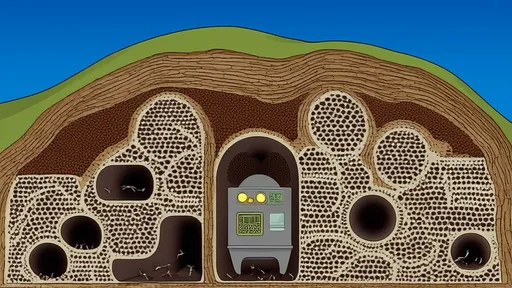
What makes these nests so efficient? The answer lies in their sophisticated design. The ants construct a network of tunnels and chambers with specific geometries that facilitate airflow. Central shafts act as chimneys, drawing warm air upward and out of the nest, while cooler air is pulled in through peripheral openings. This creates a continuous convection current, much like how traditional windcatchers function in ancient Persian architecture. The ants also adjust the nest's depth and tunnel size in response to seasonal changes, further optimizing thermal regulation.
Beyond ventilation, the ants manage humidity with equal precision. Fungus gardens require high humidity, but excess moisture can lead to mold growth. The ants solve this by constructing "waste chambers" where they deposit spent fungus and other organic material. These chambers absorb excess moisture, acting as natural dehumidifiers. Some species even create specialized vents to release excess humidity while retaining enough to keep the fungus healthy.
Translating this biological ingenuity into human technology is the next frontier. Architects and engineers are exploring how to replicate the ants' passive cooling strategies in modern buildings. One approach involves designing structures with vertically stacked chambers and strategically placed vents to encourage natural airflow. Another focuses on using porous, moisture-absorbing materials in walls to regulate indoor humidity without mechanical systems. Early prototypes have shown promise, particularly in arid and tropical climates where conventional air conditioning is energy-intensive.
The implications for sustainable architecture are profound. Buildings account for nearly 40% of global energy consumption, with a significant portion dedicated to heating and cooling. If biomimetic designs inspired by leafcutter ants can reduce or eliminate this demand, the impact on carbon emissions could be substantial. Some researchers envision future cities where skyscrapers incorporate "living walls" that mimic the thermal regulation of ant nests, drastically cutting energy use while maintaining comfort.
However, challenges remain. Scaling up nature's solutions to human-sized structures isn't straightforward. Ant nests benefit from the insulating properties of soil, which helps buffer temperature extremes. Replicating this in above-ground buildings requires innovative materials that can provide similar insulation without excessive bulk. There's also the question of adaptability—ants constantly modify their nests, while human buildings are typically static. Incorporating responsive, dynamic elements into architecture could be key to making these systems viable long-term.
Despite these hurdles, the progress is encouraging. Several research institutions have partnered with architectural firms to test ant-inspired designs in real-world settings. One experimental building in Costa Rica, modeled after leafcutter ant nest principles, reportedly maintains indoor temperatures 5-7°C cooler than the surrounding environment without any mechanical cooling. Such successes are driving increased interest and investment in biomimetic architecture solutions.
As climate change intensifies and energy demands grow, looking to nature's time-tested solutions becomes ever more crucial. The humble leafcutter ant, often overlooked as just another forest insect, may hold vital clues for creating sustainable human habitats. Their climate-smart nests demonstrate that sometimes, the most advanced technology isn't something we invent—it's something we observe and adapt from the natural world around us.
By /Aug 18, 2025
By /Aug 27, 2025

By /Aug 27, 2025
By /Aug 18, 2025

By /Aug 27, 2025
By /Aug 27, 2025
By /Aug 18, 2025
By /Aug 18, 2025

By /Aug 18, 2025

By /Aug 18, 2025

By /Aug 18, 2025
By /Aug 18, 2025

By /Aug 27, 2025

By /Aug 18, 2025
By /Aug 18, 2025

By /Aug 18, 2025
By /Aug 18, 2025

By /Aug 18, 2025
By /Aug 18, 2025
By /Aug 18, 2025