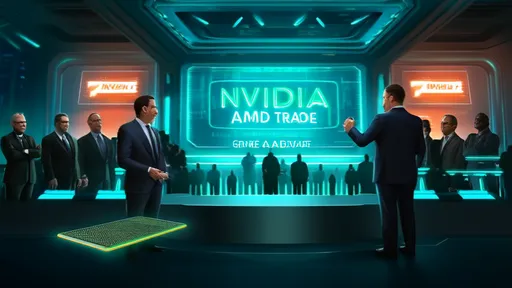
The global semiconductor landscape has undergone a seismic shift as NVIDIA and AMD, two of the world's leading chip designers, have entered into a new agreement with the U.S. government regarding the export of advanced computing chips, particularly to certain regions, most notably China. This arrangement, which industry insiders have colloquially dubbed a "protection fee" model, represents a significant evolution in how national security concerns are being integrated into the commercial strategies of tech giants. Rather than an outright ban, this model institutes a framework where exports can proceed, but under specific financial and regulatory conditions that effectively serve as a cost for market access, aligning corporate revenue with governmental oversight.
At the heart of this agreement is the U.S. government's escalating concern over the potential military and strategic applications of high-performance semiconductors. Chips designed by NVIDIA and AMD, especially those used in artificial intelligence, data centers, and supercomputing, are considered dual-use technologies—they can fuel both civilian innovation and advanced military systems. The fear in Washington is that unfettered exports could inadvertently bolster the technological capabilities of geopolitical rivals, thereby undermining U.S. national security interests. This deal is not merely a reactive policy but a proactive measure to control the flow of critical technology without completely severing lucrative commercial ties.
The term "protection fee" is evocative because it implies a transactional relationship. In this case, the fee is not a direct monetary payment but a complex structure of compliance costs, licensing agreements, and potential profit-sharing mechanisms dictated by the new export controls. For NVIDIA and AMD, this means that selling advanced chips to markets like China is no longer a simple matter of free trade. It requires navigating a labyrinth of regulations, obtaining specific licenses, and likely accepting lower margins or shared revenues with the government as a form of premium for the privilege of market entry. This system effectively monetizes the risk mitigation for national security.
From a corporate perspective, this model presents a paradoxical blend of constraint and opportunity. On one hand, it imposes undeniable limitations on market reach and operational freedom. NVIDIA and AMD must now factor in these "fees"—whether in the form of delayed timelines, reduced sales volumes, or direct financial levies—into their business strategies for key regions. This could dampen growth projections in the short term and force a reevaluation of global supply chains. On the other hand, by acquiescing to this framework, the companies secure a conditional pathway to continue operations in critical markets, avoiding a total shutdown of revenue streams from these areas. It is a pragmatic compromise between profit and policy.
The implications for the global tech industry are profound. This agreement sets a precedent that other nations and companies will undoubtedly scrutinize. It signals a new era where trade in cutting-edge technology is increasingly contingent on geopolitical alignments and security considerations, not just market dynamics. Competitors and partners worldwide may begin to anticipate similar arrangements, leading to a more fragmented and regulated global semiconductor market. For China, this model represents a new form of technological containment, potentially accelerating its drive for self-sufficiency in chip design and manufacturing to avoid such external constraints.
Market reactions have been mixed but telling. Investors initially greeted the news with caution, concerned about the immediate financial impact on NVIDIA and AMD. Stock prices experienced volatility as analysts digested the long-term implications of reduced access to one of the world's largest semiconductor markets. However, some stability returned as it became clear that the alternative—a complete ban—would have been far more damaging. The "protection fee" model, while not ideal, offers a semblance of predictability and continuity, allowing for some level of planning and strategy adjustment.
Technologically, this agreement may spur innovation in unexpected directions. With certain export channels now more costly and complicated, NVIDIA and AMD might accelerate the development of new product lines specifically tailored to comply with these regulations—chips that are powerful enough for commercial applications but fall just below the thresholds that trigger the strictest controls. Alternatively, they might invest more heavily in markets outside the purview of these restrictions, diversifying their global footprint to mitigate risks associated with any single region.
In the broader context of U.S.-China tech relations, this move is another escalation in the ongoing tech war. It follows a series of measures aimed at curbing China's access to advanced technology, from Huawei sanctions to restrictions on semiconductor manufacturing equipment. The "protection fee" model is a more nuanced tool, however. Instead of a blunt instrument, it is a calibrated mechanism designed to exert pressure while preserving some economic benefits. It reflects an understanding that complete decoupling is impractical but that uncontrolled technology transfer is unacceptable.
Looking ahead, the sustainability of this model will be tested. It relies on a delicate balance between enforcing security protocols and maintaining the commercial viability of U.S. tech firms. If the compliance costs become too burdensome, companies might push back or seek loopholes. Conversely, if security threats escalate, the government might tighten the screws further, potentially morphing the "fee" into a de facto prohibition. The international community, particularly allies in Europe and Asia, will also watch closely, as their own companies may face pressure to adopt similar measures or risk being sidelined in the U.S. market.
Ultimately, the NVIDIA-AMD agreement with the U.S. government is a landmark development in the intersection of technology, trade, and national security. It institutionalizes a system where advanced chip exports come with strings attached—strings that have tangible financial and operational costs. This "protection fee" model may well become a blueprint for how democratic nations manage the export of sensitive technologies in an increasingly contested world. For now, it stands as a testament to the complex compromises required when corporate ambitions collide with national imperatives.

By /Sep 15, 2025

By /Sep 15, 2025

By /Sep 15, 2025

By /Sep 15, 2025

By /Sep 15, 2025

By /Sep 15, 2025

By /Sep 15, 2025

By /Sep 15, 2025

By /Sep 15, 2025
By /Sep 15, 2025

By /Sep 15, 2025

By /Sep 15, 2025

By /Sep 15, 2025

By /Sep 15, 2025

By /Sep 15, 2025

By /Sep 15, 2025

By /Sep 15, 2025

By /Sep 15, 2025

By /Sep 15, 2025

By /Sep 15, 2025