The global industrial robotics sector has recorded a remarkable 12.6% surge in manufacturing sales revenue, signaling a pivotal shift toward intelligent automation as a core driver of modern industrial growth. This substantial uptick reflects not merely a recovery from pandemic-induced disruptions but a fundamental restructuring of production philosophies worldwide. As traditional manufacturing grapples with supply chain vulnerabilities and labor shortages, smart manufacturing technologies are emerging as the definitive solution, injecting fresh momentum into industrial economies across developed and emerging markets alike.
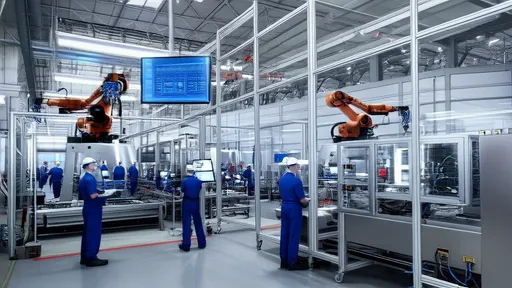
Behind this double-digit growth lies a convergence of technological maturation and urgent operational necessity. Industrial robots are no longer confined to repetitive, high-volume tasks in automotive or electronics assembly lines. The latest generation of collaborative robots, or cobots, now work alongside human operators in sectors ranging from pharmaceuticals to food processing, while AI-enhanced vision systems and real-time data analytics enable unprecedented levels of precision and adaptability. This expansion into diverse applications has substantially widened the addressable market, driving both unit sales and the value of integrated solutions.
Supply chain reconfiguration represents another critical factor fueling this growth. The pandemic exposed the fragility of globally distributed production networks, prompting many companies to reshore or nearshore manufacturing activities. In this context, robotics offers a compelling value proposition: automated facilities can operate consistently with minimal human intervention, reducing dependency on overseas labor and mitigating logistics risks. Nations are also recognizing strategic autonomy in manufacturing as a matter of economic security, leading to policy incentives for adopting advanced production technologies.
The integration of Industrial Internet of Things (IIoT) platforms has been a game-changer, transforming standalone robots into interconnected nodes within a broader digital ecosystem. These smart systems collect and analyze operational data continuously, enabling predictive maintenance, optimizing energy consumption, and dynamically adjusting production parameters in response to real-time demand signals. This connectivity turns manufacturing lines from static cost centers into agile, responsive assets capable of mass customization and rapid product changeovers.
China's role in this expansion cannot be overstated. As both the world's largest market and an increasingly sophisticated manufacturer of industrial robots, Chinese companies are driving down costs while expanding capabilities. Domestic manufacturers have made significant strides in developing core components like precision reducers and servo motors, reducing reliance on imports and making automation more accessible to small and medium enterprises. This democratization of technology is accelerating adoption across price-sensitive segments globally.
Meanwhile, labor dynamics continue to reshape the automation landscape. Demographic shifts in developed nations have created persistent workforce shortages in manufacturing, while rising wages in traditionally low-cost regions have eroded the economic advantages of offshore production. Robots fill this gap not by replacing workers entirely but by augmenting human capabilities and taking over hazardous or ergonomically challenging tasks. The most successful implementations focus on human-robot collaboration, creating hybrid work environments that leverage the strengths of both.
The sustainability imperative is further accelerating adoption. Modern manufacturing faces increasing pressure to reduce environmental impact through energy efficiency, waste reduction, and circular production models. Smart robotics contribute significantly to these goals through precise material application, optimized resource utilization, and data-driven process improvements that minimize scrap rates. Automated systems can also operate in lights-out facilities, dramatically reducing energy consumption associated with lighting, heating, and cooling in traditional factories.
Looking ahead, several technological frontiers promise to sustain this growth trajectory. 5G connectivity is enabling wireless industrial automation with ultra-low latency, facilitating more flexible factory layouts and mobile robotic applications. Advances in machine learning are creating robots that can learn from demonstration and adapt to unstructured environments without extensive reprogramming. These developments are gradually breaking down the remaining barriers to automation in industries with highly variable products or processes.
However, challenges remain on the path to widespread adoption. The high initial investment required for comprehensive automation still presents a barrier for many small manufacturers, despite decreasing hardware costs. There is also a significant skills gap in designing, implementing, and maintaining these complex systems, requiring substantial workforce retraining and new educational initiatives. Cybersecurity concerns grow as production systems become more connected, necessitating robust protection for critical manufacturing infrastructure.
The 12.6% revenue growth ultimately tells a story of transformation rather than mere expansion. We are witnessing the emergence of a new industrial paradigm where physical production converges with digital intelligence, creating manufacturing systems that are not only more efficient but more resilient, adaptable, and sustainable. This evolution represents nothing less than the fourth industrial revolution in action, with intelligent robotics serving as both its foundation and its driving force. As these technologies continue to mature and proliferate, they will redefine what's possible in manufacturing while creating new competitive dynamics across global industry.

By /Sep 15, 2025

By /Sep 15, 2025

By /Sep 15, 2025

By /Sep 15, 2025

By /Sep 15, 2025

By /Sep 15, 2025

By /Sep 15, 2025
By /Sep 15, 2025

By /Sep 15, 2025

By /Sep 15, 2025

By /Sep 15, 2025

By /Sep 15, 2025

By /Sep 15, 2025

By /Sep 15, 2025

By /Sep 15, 2025

By /Sep 15, 2025
By /Sep 15, 2025

By /Sep 15, 2025

By /Sep 15, 2025

By /Sep 15, 2025